Mounting · Hardware · Modules · Inverters · Storage
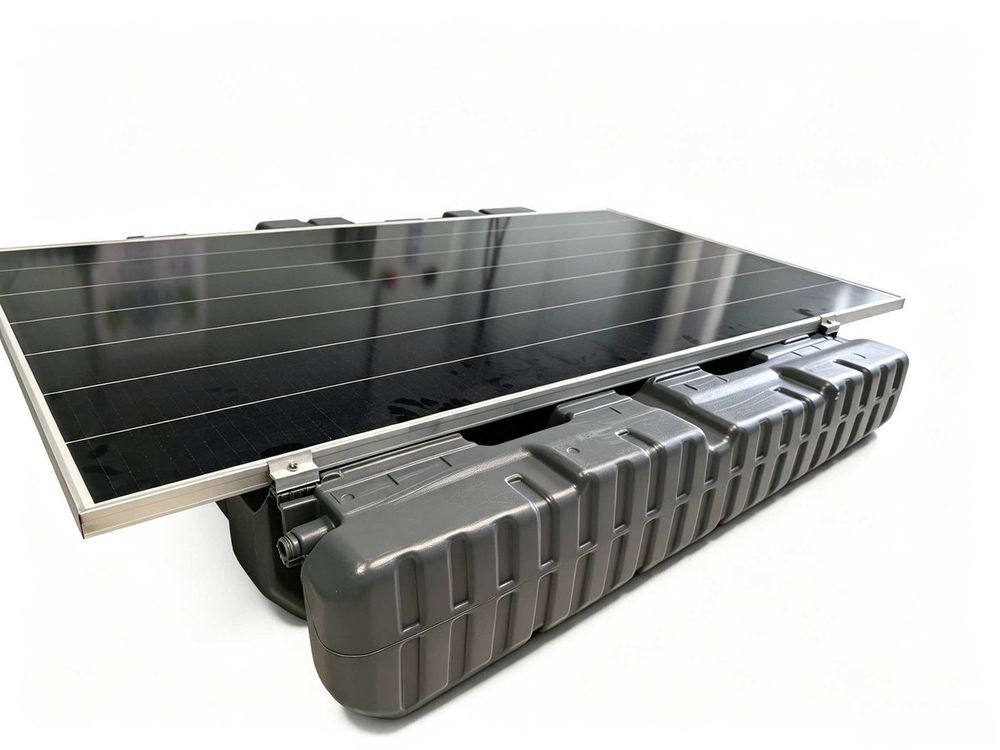
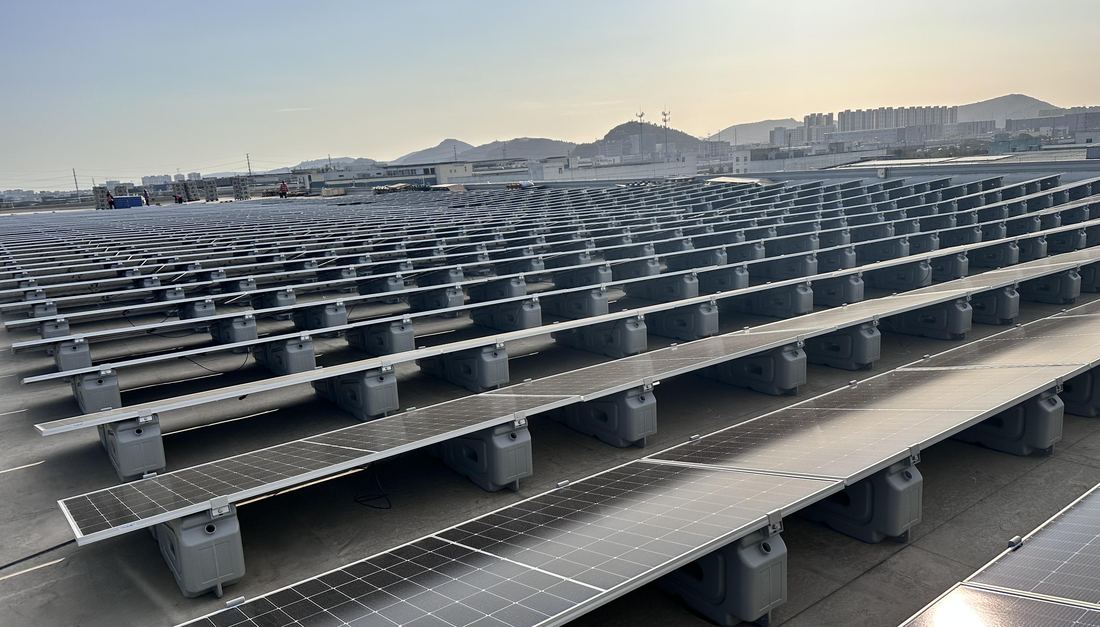
Non-penetrating HDPE ballast units — 6.3 kg empty, 120 kg filled, no waterproofing repair, no crane. When a project calls for steel instead, we also supply hot-dip galvanised racking, ground screws, clamps and the balance-of-system parts that usually mean three more suppliers.
The problem
On an existing industrial roof, drilling for anchor bolts cuts through the waterproof membrane. Repairs are temporary, warranties are voided, and the client carries the risk for 25 years. Concrete ballast solves the penetration problem but adds 30 kg blocks, crane lifts and structural load.
| Item | Drilled / anchored racking | DINGXIU water ballast |
|---|---|---|
| Roof membrane | Penetrated at every anchor; repair required | Zero penetration, membrane untouched |
| Crew | Certified installers needed | General labour can install |
| Lifting | Crane or hoist for rails and blocks | Carried by hand, no machinery |
| Ballast | Concrete blocks purchased and lifted | Water from the site tap, zero material cost |
| Schedule | ~30 days per MW | ~12 days per MW |
| Relocation | Effectively permanent | Drain and move, fully reusable |
How it works
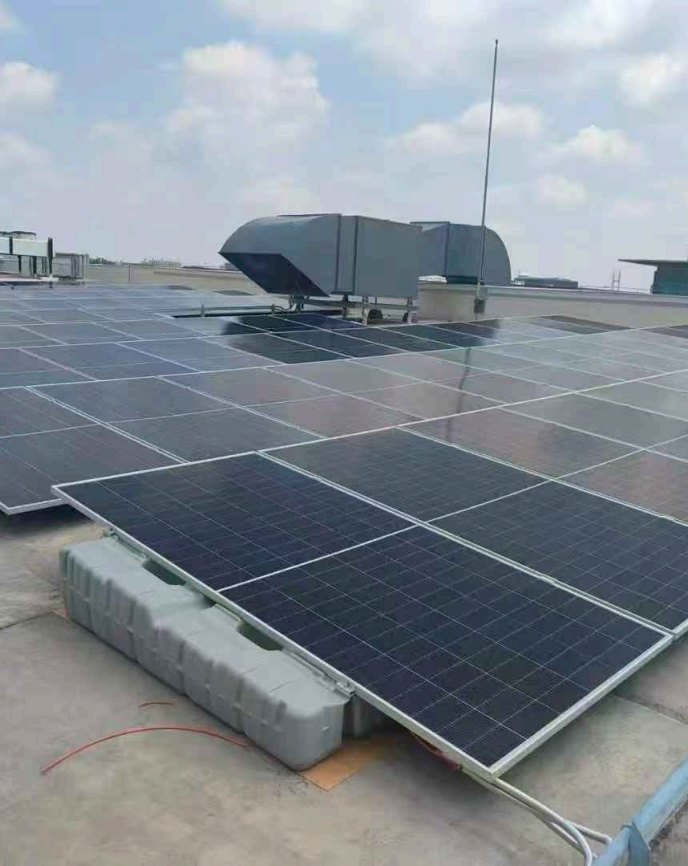
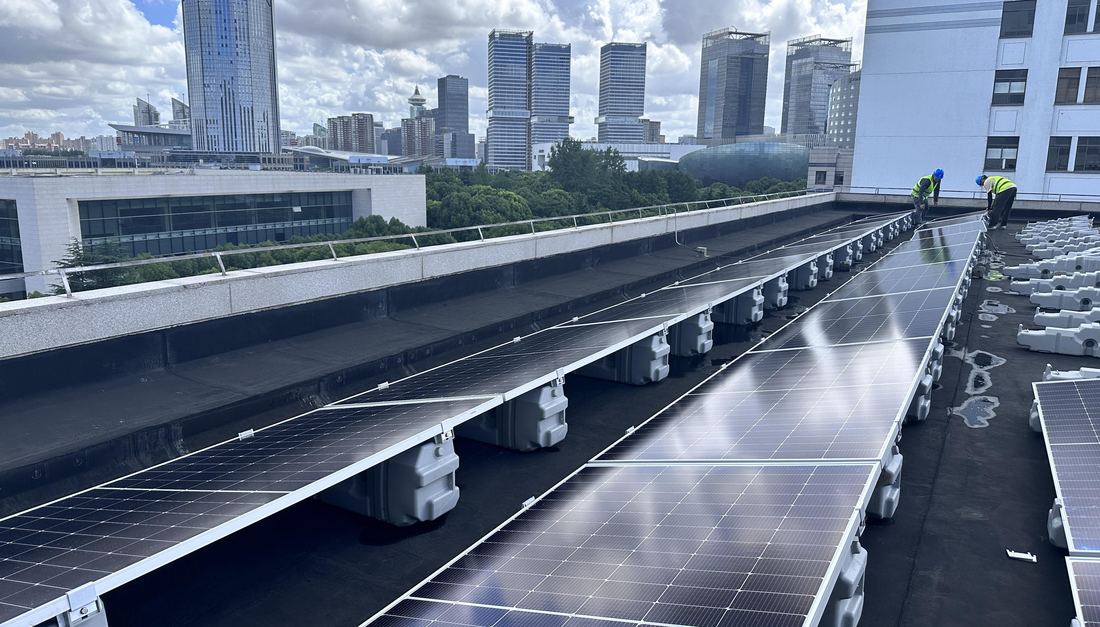
The tank is a sealed HDPE box. Placed under the joint between two modules, it supports the frames and, once filled, its own weight resists wind uplift. Clean water only — no sand, no gravel, so nothing settles or abrades the wall from inside.
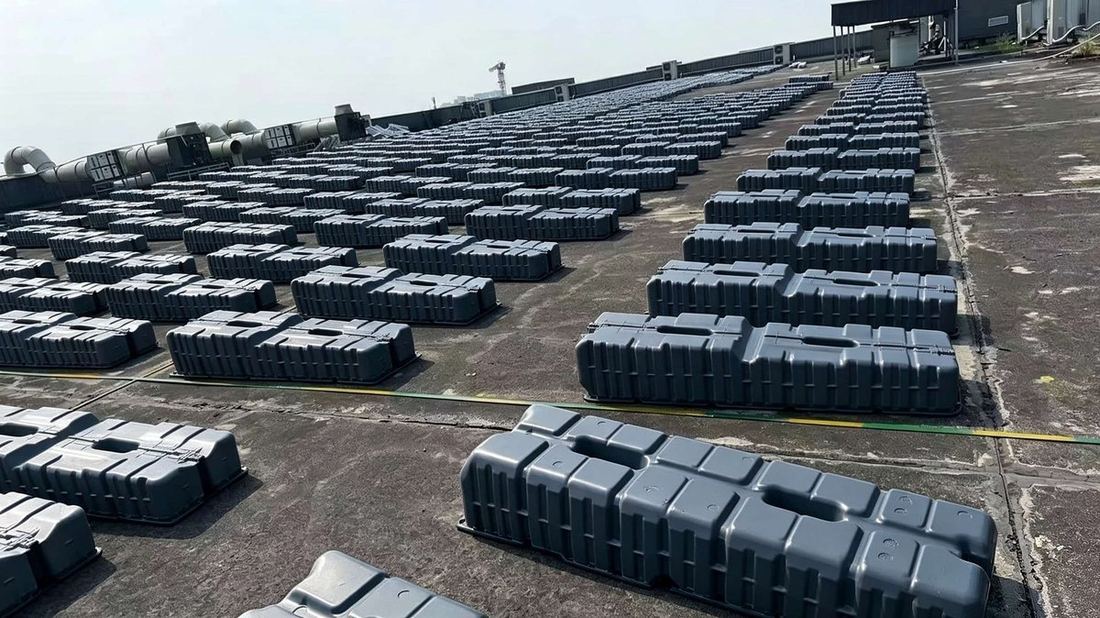
Lay out tanks along the module rows. Empty units are light enough for one person to reposition by hand.
Modules go in portrait. Each tank sits under the seam between two adjacent modules and takes the frame on both sides.
Middle clamps tie the adjacent frames together, end clamps finish the row edges. One bolt each, hand-tightened.
Fill with water on site. The array becomes a ballasted system without a single fixing into the structure.
DC strings and commissioning as normal. Nothing below the membrane has changed.
Adjacent modules share one tank at the seam. A 20-module row needs 21 units and 42 end clamps.


Why buyers choose it
Material cost per watt is roughly on par with conventional rail systems. The saving comes from everything around the material: no waterproofing repair, no crane, no concrete blocks, no specialist crew, and three weeks of earlier generation.
No penetration means the roofing contractor's warranty stays intact — often the single biggest objection on existing buildings.
About 12 days per MW against roughly 30 for drilled racking, on our customers' own comparisons. Earlier commissioning means earlier revenue.
Four steps, no torque specification on the roof, no drilling equipment. Crews can be hired locally instead of brought in.
6.3 kg empty. Two workers move and place units all day without a hoist or a crane on the roof.
Clamps are specified by frame thickness — a middle set and an end set. Changing module brand does not change the racking.
Drain, unclamp, carry away. Useful for temporary sites, roof maintenance access and array relocation.
Applications
· Flat concrete roofs and cast-in-place decks
· Industrial and warehouse roofs with existing waterproofing
· Roofs where penetration is contractually forbidden
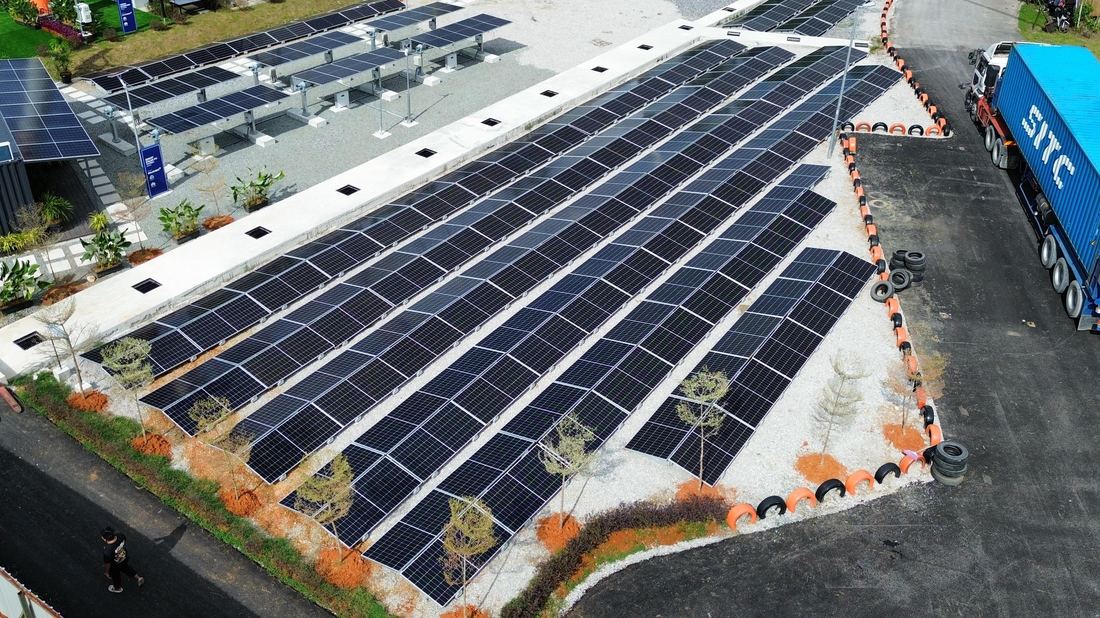
· Level ground and hardstanding
· Distributed projects where the roof cannot be altered
· Pitched or curved roofs
· Light metal roofs without structural capacity for ballast
· Roofs with load limits below the calculated ballast weight
· Sites where wind exposure exceeds the tested pressure
· Ground-mount projects needing pile foundations — we supply helical ground screws for those →
Send us the roof drawing, the module datasheet and the site location. We return a layout and a unit count — free of charge.
Product range
The ballast unit is the headline, but it is rarely the only line on a purchase order. Rails, clamps, earthing, MC4 protection, modules, inverters and batteries leave the same warehouse — one container, one set of export documents, one invoice.
HDPE water ballast units for flat concrete and membrane roofs. 6.3 kg empty, 120 kg filled, zero penetrations.
View system →Hot-dip galvanised ground and roof structures, plus Zn-Al-Mg rails held at full 30×4.0 mm section.
View section →Helical piles for ground-mount, carport and fence foundations. 1,600 units shipped on a single order.
View section →Mid and end clamps, one-piece clamps, export corner brackets, flat bar and channel nuts — plenty in stock.
View section →Yellow-green grounding jumpers, extended earth leads, copper lugs, MC4 connectors and 1000 V / 1500 V fire covers.
View section →Aluminium inverter covers cut to your model, stainless rain hoods, M-gutter and cable tray.
View section →Tier-1 monocrystalline and bifacial modules, N-type TOPCon, quoted against your approved vendor list.
View section →3–110 kW on-grid, plus hybrid and off-grid units with the certification pack for your submittal.
View section →LFP wall, rack and cabinet systems from 5 to 100 kWh, shipped on the same declaration as the mounting.
View section →Logistics
Two units nest into about 0.32 m³, roughly six sets per cubic metre. That density is what makes a plastic product economical to export — the freight per set stays low even though the cargo is volumetric.
| Loading | Quantity | Note |
|---|---|---|
| 20GP container | 197 sets | Confirmed loading |
| 40GP container | 350–360 sets | Calculated on 9 layers |
| 40HC container | 400 sets | Calculated on 10 layers |
| 13 m flatbed truck | 450 sets | Actual loading record |
400 sets weigh about 2.5 tonnes in total. Freight is charged on volume, so ask us for the CBM per set before you quote your customer.
Wind resistance
The system was pull-out tested at 0.55 kN/m² (550 Pa) uplift with no tearing and no failure at the clamp. Converted to wind speed at standard air density (1.225 kg/m³), that is a pressure equal to a wind of about 30 m/s — 108 km/h, Beaufort 11.
| Wind speed | Dynamic pressure | Beaufort | Against our tested 0.55 kN/m² |
|---|---|---|---|
| 20 m/s (72 km/h) | 0.245 kN/m² | 8 | Within tested range |
| 25 m/s (90 km/h) | 0.383 kN/m² | 10 | Within tested range |
| 30 m/s (108 km/h) | 0.551 kN/m² | 11 | At the tested limit |
| 35 m/s (126 km/h) | 0.750 kN/m² | 12 | Above tested range — ask us |
| 40 m/s (144 km/h) | 0.980 kN/m² | 12+ | Above tested range — ask us |
Formula: pressure q = 0.5 × ρ × v², with ρ = 1.225 kg/m³ at 15 °C and sea level. Look up the design wind speed or design pressure your local code requires for the building, compare it to the table, and you have your answer.
What we publish is the pressure the product was tested to. What your roof must be designed for depends on local code, roof height, terrain exposure and the shape factor of the array — that is a decision for your structural engineer, and the ballast calculation is issued per project. We will run that calculation for you once we know the site.
Certification
Test reports and the patent certificate are available on request. Report numbers can be verified with the issuing laboratory.
Project references
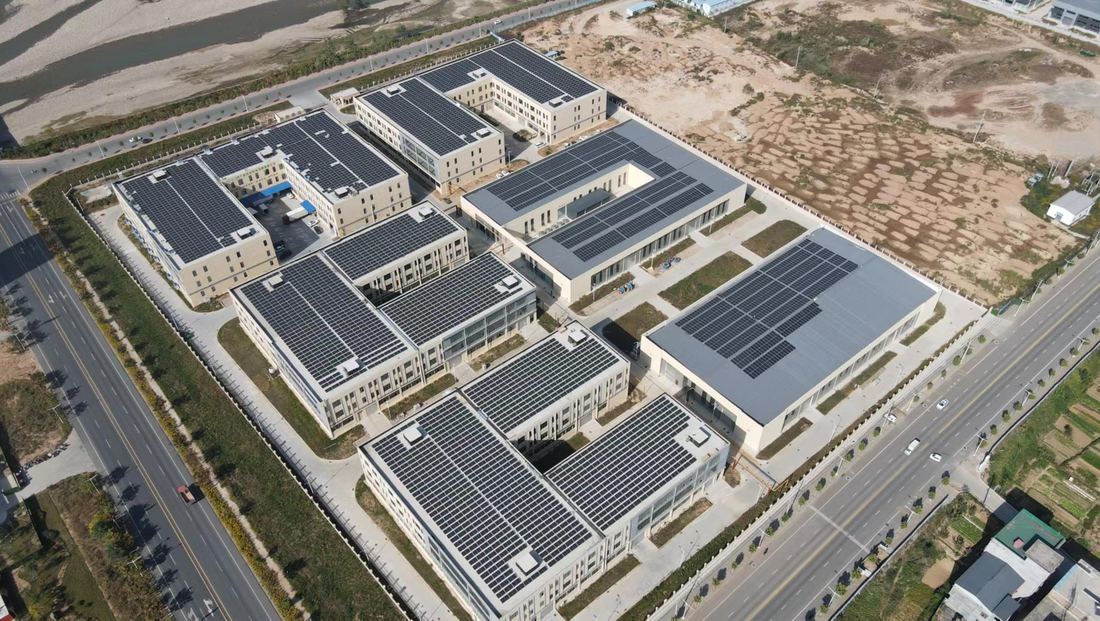
Every photograph below is a delivered installation of the system we supply — industrial campuses, a provincial library, government buildings and ground-mounted arrays. Nothing is a 3D render.


Technical guides
The calculations behind the product — ballast weight, roof load, wind uplift, roof types. Written from our own unit weights and support counts, so you can check the numbers instead of trusting a brochure.
Supports per row = modules + 1. One filled unit is 120 kg. How those two numbers become roughly 45 kg/m² of roof load — with a scale table from 10 kWp to 1 MWp.
Read the guide → Thailand · programme termsTHB 50,000 per household for 5–10 kWp, one million homes, all connected by 30 September 2027. The dates, the guarantee rule, and the parts that stop a crew.
Read the note → All guidesFive notes covering the questions that come up in every flat roof enquiry: ballast, wind uplift, roof load limits, which roofs accept a ballast system, and installing without drilling.
Browse the series →Roof area, module model and site location is enough to start. You get a unit count, a ballast check against your wind zone, container loading and a quotation — at no cost.